On October 13, 2026, the Federal Communications Commission (FCC) Final Rule 26-50 officially came into effect. This rule restructures the review logic of FCC ID equipment authorization, extending the regulatory boundary from finished product compliance down to the traceability of core logic hardware components at the PCB board level. It marks that the market access for radio frequency (RF) electronic devices in the US has officially entered the stage of supply chain penetration review.
I. Core Regulatory Upgrade: From Finished Product Verification to Component Traceability
Previously, FCC's supply chain security controls only covered the finished product level. Complete devices manufactured by entities on the Covered List were excluded from FCC ID authorization, while third-party brands that assembled finished products with core components purchased from enterprises on the list could still apply for certification normally.
Rule 26-50 fills this regulatory gap: if a device is equipped with logic-bearing hardware components manufactured by entities on the Covered List, and the corresponding finished product manufacturer is subject to the FCC authorization ban, the finished device will also be ineligible for FCC ID authorization. In short, even if the applicant and the finished product brand are not on the Covered List, the certification application will be directly rejected if the source of core logic components on the PCB board fails to meet the requirements.
II. Clarified Regulatory Boundaries: Defined Scope of Components and Products
The new rule does not cover all electronic components, but sets technical judgment criteria only for logic-bearing hardware, based on which enterprises can conduct self-inspection.
Two categories of core regulated components are subject to key verification:
1.Devices operating with sequential signals above 9 kHz and adopting digital technology;
2.Physical components that perform functions such as calculation, storage and data transmission using radio frequency energy.
In terms of finished products, core devices with programmable and data processing capabilities, including main control SoCs, Wi-Fi/Bluetooth wireless modules, baseband chips, MCUs and DSPs, are all key traceability targets. Passive components and purely mechanical parts, such as resistors, capacitors, ordinary PCB substrates, connectors, structural housings and ordinary battery cells, are not within the regulatory scope and do not require special traceability.
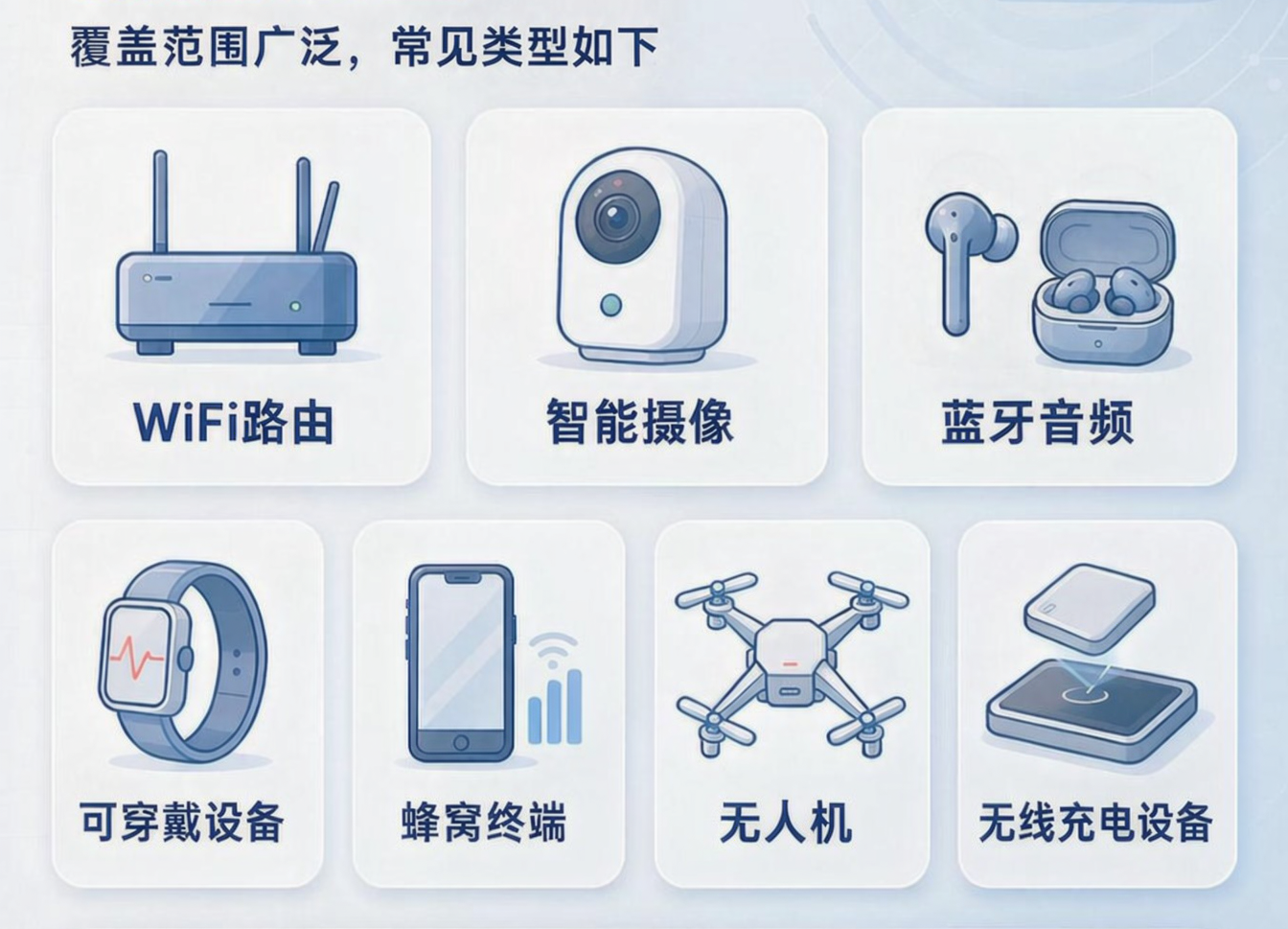
Regarding the scope of affected products, entities on the Covered List are mainly specific communication and security enterprises and their affiliated entities, and the core logic components they produce will directly trigger certification restrictions. All RF wireless products requiring FCC ID application are covered by the new rule, including Wi-Fi routers, smart cameras, Bluetooth audio devices, wearables, cellular terminals, drones and wireless charging devices. Part 15B products without RF emission that only require the Supplier's Declaration of Conformity (SDoC) are not subject to this component ban.
III. Scenario-Based Determination: Applicable Rules for Projects at Different Stages
The new rule follows the principle of non-retroactivity. The applicable rules for certification projects at different stages are as follows:
Project Stage | Applicable Rule | Key Points |
Existing certified products | Certificates remain valid | Products certified before October 13 can be cleared and sold normally without retrospective enforcement |
Hardware revision of existing products | Re-certification under the new rule | Replacement of core logic components such as main controllers and wireless modules cannot go through the simplified change process |
Ongoing review projects | Determined based on changes | Old rules apply if no core component changes are involved; new rules apply if core components are changed midway |
Newly launched / newly submitted projects | Full implementation of new rules | All FCC ID projects launched and submitted after October 13 are subject to component penetration review rules |
IV. Enterprise Compliance Implementation: Full-Process Risk Prevention and Control
After the implementation of the new rule, the review cycle of FCC ID certification will be lengthened, and supply chain verification will also increase pre-workload. It is recommended that enterprises build a compliance system from four links:
1.Component selection and project initiation: Front-load supply chain screening When launching new projects, sort out the BOM of each PCB board simultaneously, clarify the brand and actual manufacturer of core chips and modules, and complete preliminary screening against the FCC Covered List. Replace components with compliance risks as early as possible to avoid certification rejection after testing and resulting cost losses.
2.Document management: Improve traceability technical files Sort out supplier qualifications, procurement vouchers and source certificates of core logic components, and establish technical files with one-to-one correspondence between product models, core devices and manufacturers, to ensure rapid response to TCB traceability requirements during review and reduce supplementary material time.
3.Certification execution: Pre-review first, then test It is recommended to entrust a professional testing institution to complete BOM supply chain pre-review before formal testing, and start RF and safety tests only after confirming the solution is compliant, so as to avoid solution risks and shorten the overall certification cycle.
4.Channel compliance: Update online platform information simultaneously Cross-border e-commerce platforms such as Amazon have simultaneously strengthened FCC compliance inspections, requiring FCC ID information to be clearly displayed on product pages. Cross-border sellers are advised to complete self-inspection of all listings in the store, supplement compliance labels, and avoid the risk of listing removal.
From finished product control to component penetration, and from performance compliance to supply chain compliance, the implementation of FCC 26-50 marks that the access supervision of RF products in the US has entered a refined stage. For export enterprises, the focus of compliance can no longer stay only on product testing; extending upward to supply chain selection and full-life-cycle management of components has become an inevitable trend.