Dear partners in the battery production, export, and freight forwarding industries, attention please! The "compliance exam" for year-end exports has entered the preparation stage. Every fourth quarter is a busy period for battery transportation inspections. Many enterprises have encountered problems such as booking containers being refused, cargo being detained at the port, and additional storage rental deductions due to issues like expired reports, outdated packaging labels, and incorrect information. They have been in a state of panic trying to make temporary corrections.
The update channel for the 2027 annual cargo transportation inspection reports has been opened. In line with the latest regulatory requirements, China Certification and Accreditation Association for Batteries has comprehensively sorted out the core deadlines, label changes, information discrepancies, and key points for avoiding pitfalls for battery export re-certification.
1. Remember the time limit: Reports expire at the end of the year in the same year. Those for the following year are always invalid.
This is the point that many enterprises tend to get wrong: The validity period of the cargo transportation condition inspection report is not "extended for one year after processing", but it naturally expires at the end of the year. All the "Cargo Transportation Condition Inspection Reports" issued in 2026, regardless of whether they were processed in February or November, have a validity period that ends on December 31, 2026. Starting from January 1, 2027, freight forwarders, airlines, and shipping companies will completely stop accepting old versions of the reports for booking containers and customs declaration. That means orders with shipping plans after New Year's Day can now start the report update process.
2. Major adjustment in 2027: New labels for lithium battery packaging, old versions to be discontinued by the end of the year
In line with the revised content of IATA's 68th edition of the "Dangerous Goods Regulations" (DGR 2027), the packaging labels for lithium battery transportation have undergone a clear redesign. The old version is now in the transition phase of withdrawal.
• Old labels: Include the lithium battery logo, UN number, and contact information
• New labels: Keep the lithium battery logo and UN number, and officially remove the contact number column
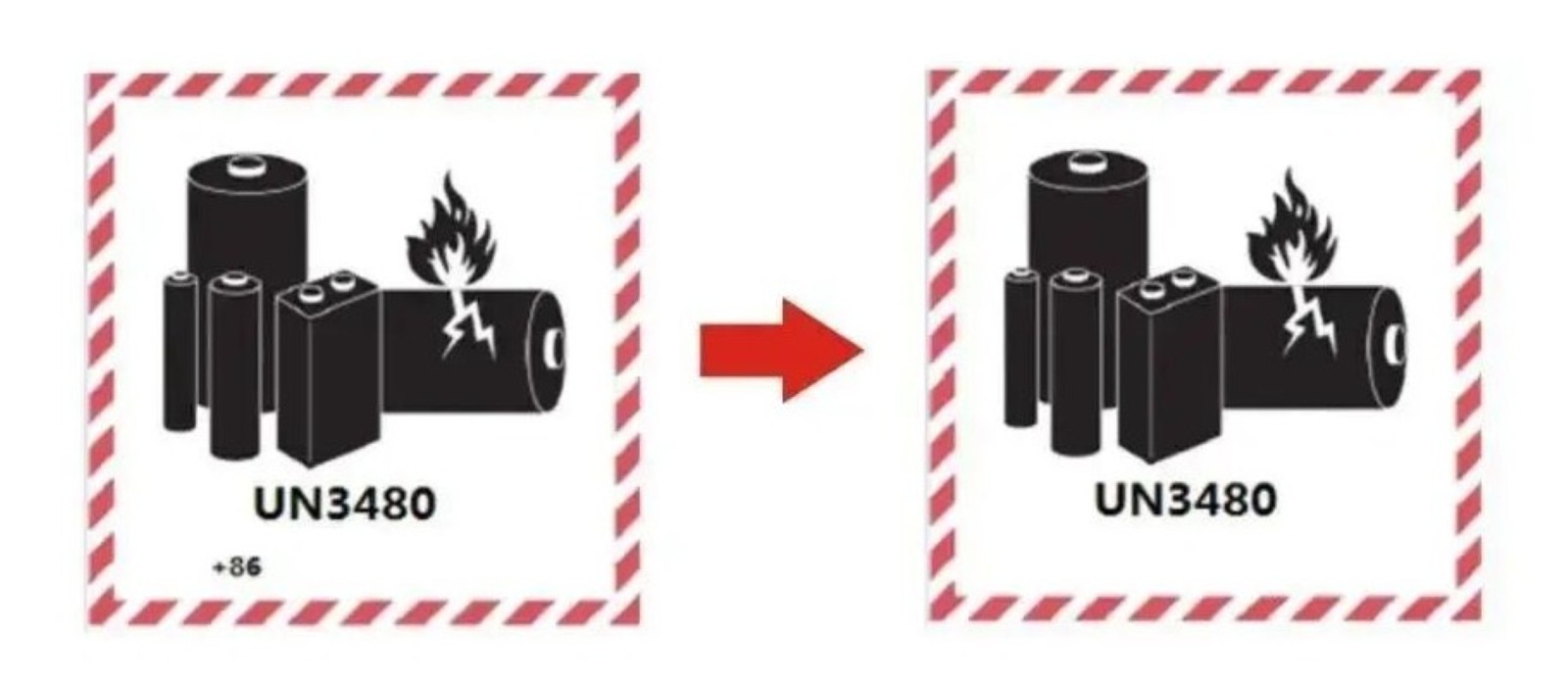
Lithium battery identification labels
December 31, 2026 is the final transition period for the old labels. Starting from January 1, 2027, all exports must use the new labels.
Here is a special clarification of a frequent misunderstanding: The lithium battery identification label (Lithium Battery Mark) ≠ the 9th class dangerous goods label. Their functions are completely different and cannot be substituted. Categories like UN3480 (lithium-ion batteries transported alone) and UN3481 (lithium batteries and equipment transported together / embedded in equipment) require both the lithium battery identification label and the dangerous goods classification label to be met. Missing any one will not pass the logistics review.

9th class dangerous goods labels
It is recommended that enterprises now start to inventory old labels, update the outer box printing templates, and notify packaging suppliers for the label update.
3. UN38.3: Don't just ask "Is there a report?", these details can still be rejected
UN38.3 is the core compliance document for battery exports, but many enterprises only stop at "I have a report". In actual audits, situations where the test summary information is incomplete or the parameters do not match are very common.
1. The test summary information must be complete, and the parameter filling must be error-free
According to the requirements of the "United Nations Test and Standard Manual" 38.3.5, a complete test summary must include the manufacturer's name and contact information, the qualification information of the testing institution, the report number, the test date, the battery model/type/weight, the rated energy or lithium content, the test items and results, the applicable standard version, and the responsible person's information. The most prone to errors are the parameter items:
• Lithium-ion batteries: Focus on verifying the rated energy (Wh)
• Lithium-metal batteries: Focus on verifying the lithium content. Filling only the voltage and Ah capacity is not in line with the regulations and can easily be rejected by the review.
2. There is no need to retest every year, but these 5 situations must be redone.
The UN38.3 standard does not have a mandatory requirement for "annual update". As long as the product design and core parameters remain unchanged, there is no need to retest annually. However, in any of the following situations, a re-evaluation and testing must be conducted:
• Replacement of the battery cell supplier or battery cell model
• Change in the nominal model or capacity of the battery
• Adjustment of the internal structure of the battery
• Modification of the BMS protection scheme
• Change in the battery production process
It is recommended that for long-term shipment of older model products, check the consistency of "battery cell model - report parameters - actual shipped product" to avoid the low-level error of "reporting one set, delivering another set".
4. Special reminder for air transportation: Do not exceed 30% of the battery's charge state
Shippers of batteries transported by air channel should pay particular attention. Lithium-ion battery air transportation has specific requirements for the charge state (SoC), usually not exceeding 30% of the rated capacity. Before shipment, make sure to perform discharge treatment as per the airline's requirements, confirm the shipment volume, packaging method, and transportation category in advance. Don't wait until the goods arrive at the airport to find that the charge state is exceeded and be returned and reworked, causing delays in the shipping schedule.
5. Practical suggestions for avoiding pitfalls at the end of the year for renewal
1. Early processing, staggered travel: The end of the year is the peak period for the detection and appraisal industry, and the sample testing and report issuance cycles will be significantly prolonged. It is recommended to submit an update application at least 30 days in advance to avoid the situation of a large number of people queuing up in December.
2. Synchronous verification of all materials: When updating the transportation appraisal report for battery products, simultaneously verify the UN38.3 report, MSDS, and the version and validity period of the lithium battery label to ensure the consistency and compliance of the entire set of materials.
3. Make an urgent request in advance: If there is an urgent shipment requirement, it is necessary to contact the testing institution in advance to make an appointment for an urgent window. Last-minute rush applications are usually not accepted.
If there is an update arrangement for the 2027 appraisal report, you can contact Zhonglian Kekou for support to ensure that the battery export next year starts from a compliant schedule and takes a stable start.