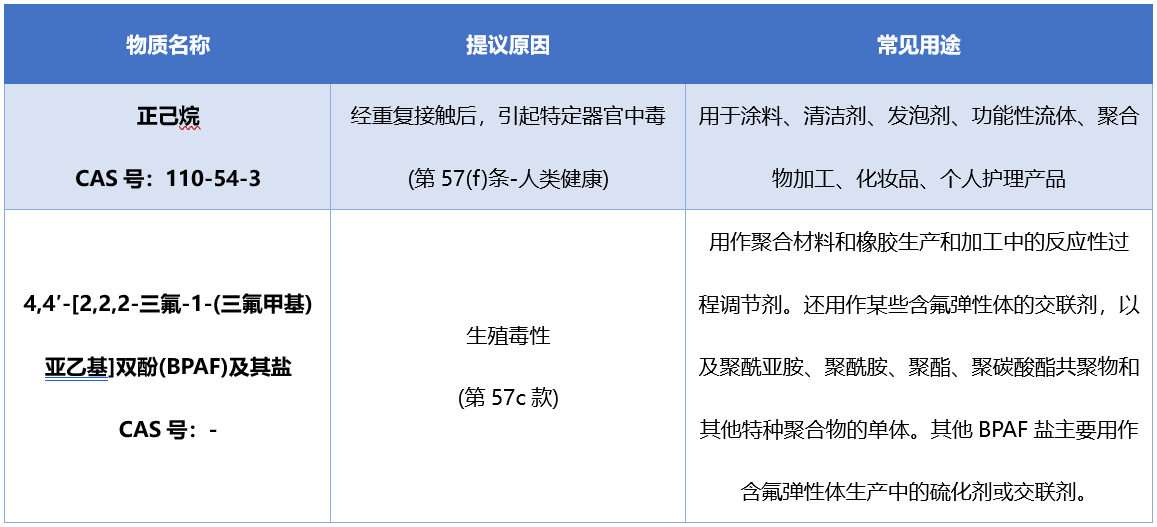
On December 15th, 2025, the Committee of Member States (MSC) of the European Chemicals Agency (ECHA) unanimously passed at its December meeting, and n-hexane was listed as substances of very high concern (SVHC). It is worth noting that this is the first substance to be included in the candidate list of SVHC because of its neurotoxicity (rather than the traditional categories such as carcinogenicity, mutagenicity and reproductive toxicity).
In addition, 4,4'-[2,2,2- trifluoro -1- (trifluoromethyl) ethylene] bisphenol (BPAF) and its salts were also included in the SVHC candidate list without discussion by the Committee.
The European Chemicals Agency (ECHA) plans to formally add the above two substances to the SVHC list in February 2026. By then, the list of REACH SVHC will increase to 253.
The new material information is as follows:
The related laws and regulations of SVHC substance require:
REACH regulations stipulate that when the content of SVHC in articles is greater than 0.1%, information must be transmitted in the supply chain; When the content of SVHC in articles is more than 0.1% and the annual export volume is more than 1 ton, it must be notified to ECHA.
According to the EU Waste Framework Directive, from January 5, 2021, suppliers who put goods with SVHC content exceeding 0.1% into the EU market should submit the relevant information of the goods to ECHA through SCIP database.
Suggestions on enterprise compliance
1. Comprehensively sort out the supply chain and lock in the source of risks: immediately carry out self-inspection in conjunction with raw material suppliers to confirm whether the product formula contains two new SVHC substances, and ask suppliers to provide the composition statement (DoC) of related substances to clarify the substance content and compliance certificate.
2. Entrust professional testing to ensure accurate data: For the high-risk products involved, entrust professional institutions with REACH testing qualifications (such as our company) to conduct targeted testing, accurately determine whether the content of new substances exceeds the standard, and avoid compliance risks caused by "self-inspection blind spots".
3. Update the compliance documents in time, and fulfill the disclosure obligations: If the content of substances detected exceeds the standard, ECHA notification shall be completed within the specified time limit, and the SDS, labels and other documents of products shall be updated to ensure the complete safety information is transmitted to the downstream, so as to avoid violations caused by missing information.
4. Establish a long-term compliance mechanism and dynamically track list updates: REACH SVHC lists are frequently updated and cover a wide range. Enterprises need to establish a normalized tracking mechanism, obtain list update information in time, arrange risk assessment and detection in advance, and avoid passively responding to policy changes.
Warm tips
Our company has a professional technical team and rich experience in product testing, which can help you easily understand whether the products are safe and compliant. If you need it, please feel free to contact us, and our engineers will serve you at the first time!