On December 12th, 2025, the European Union published the Toy Safety Regulation (EU) 2025/2509(TSR) in its Official Gazette (OJ). The regulation will take effect on January 1, 2026, 20 days after its promulgation, and will be implemented after August 1, 2030 (55 months). At that time, the current toy safety directive 2009/48/EC(TSD) will be abolished.
Compared with TSD, TSR involves the following key technical updates
1. Upgrade of legal effect: it is directly applicable to the whole EU without transformation.
◆ Core change: upgrading from "directive" to "regulation" does not need to be translated into domestic laws by EU member States, and it will be directly applicable to all member States after promulgation.
◆ Compliance tip: Enterprises need to directly produce and test the TSR standard without waiting for separate legislation in each country, so as to avoid the omission of compliance due to "national differences".
2. The scope of exemption is clear: two types of products are no longer classified as toys.
◆ Excluded categories: egg shooting equipment and reading and educational books that are used by children over 36 months and have no play value.
◆ Compliance tip: Enterprises need to reorganize the product classification. If the product falls into the above categories, it is not necessary to test according to the new toy standards, but it is necessary to confirm the corresponding compliance requirements of the category to which it belongs.
3. Digital Product Passport (DPP): replacing the traditional declaration of conformity (DoC).
◆ Core requirements: Before toys are put into the EU market, manufacturers must create a Digital Product Passport (DPP), which must contain complete compliance information (such as unique product identification, manufacturer information, compliance regulations citation, CE identification, sensitized aromatic amine list and other core information).
◆ Compliance tip: Digital Product Passport (DPP) will replace the current toy declaration of conformity (DoC), interoperate with passport systems required by other EU regulations, and be attached to toys, packages or accompanying documents through data carriers, so as to ensure that market regulators, customs, consumers and other interested parties can obtain it freely and conveniently.
4. Specification of Warning language: start with "warning"/use pictograms.
◆ Mandatory standard: All Warnings must start with the word "warning" or use general pictograms  (yellow background, black border triangle, black exclamation mark, height ≥ 10mm).
◆ Compliance tip: stipulate pictograms  (diameter ≥ 10mm) on toys that are not suitable for children under 36 months.
5. Physical and mechanical properties: Three new types of toy safety requirements were added.
◆ New control: simulated food toys, inflatable toys and toys containing magnets should meet the physical and mechanical performance requirements of the corresponding toys.
◆ Compliance tip: Enterprises involved in such products need to supplement targeted testing items to avoid being rejected into the EU market due to substandard performance.
6. Electrical performance: Focus on battery safety and strengthen the "untouchable" requirement.
◆ Specific provisions:
-Toys with small battery parts: The battery compartment should be designed to ensure that children can't touch the battery without tools.
-Toys with rechargeable batteries: If the size or function of the toys require, the batteries can be designed as "untouchable" and can only be disassembled or replaced independently by qualified professionals.
◆ Compliance tip: battery accessibility and disassembly difficulty will become the core focus of electrical safety testing, and enterprises need to optimize product structure design.
7. Hygienic requirements: microbial control of water-based materials is added.
◆ Core requirements: Toys with accessible water-based materials must pass microbial risk detection to ensure no potential safety hazards.
◆ Compliance tip: Enterprises need to add new microbial testing items, strictly control the quality of water-based materials, and avoid product compliance due to excessive microorganisms.
8. Artificial intelligence toys: three new safety assessment dimensions were added.
◆ New control: For toys integrated with artificial intelligence technology, the new regulations clearly include hazards such as network security, personal data and privacy protection, and children's mental health into the scope of safety assessment.
◆ Compliance tip: Toy enterprises with functions such as Bluetooth, Wi-Fi, mobile network connection or built-in artificial intelligence need to arrange special evaluation in advance to ensure that the products meet the corresponding regulatory requirements.
9. Chemical properties: limits and scope of application are updated.
◆ Core change: Continue TSD chemical control logic, but further tighten some harmful substance limits and update the applicable product range.
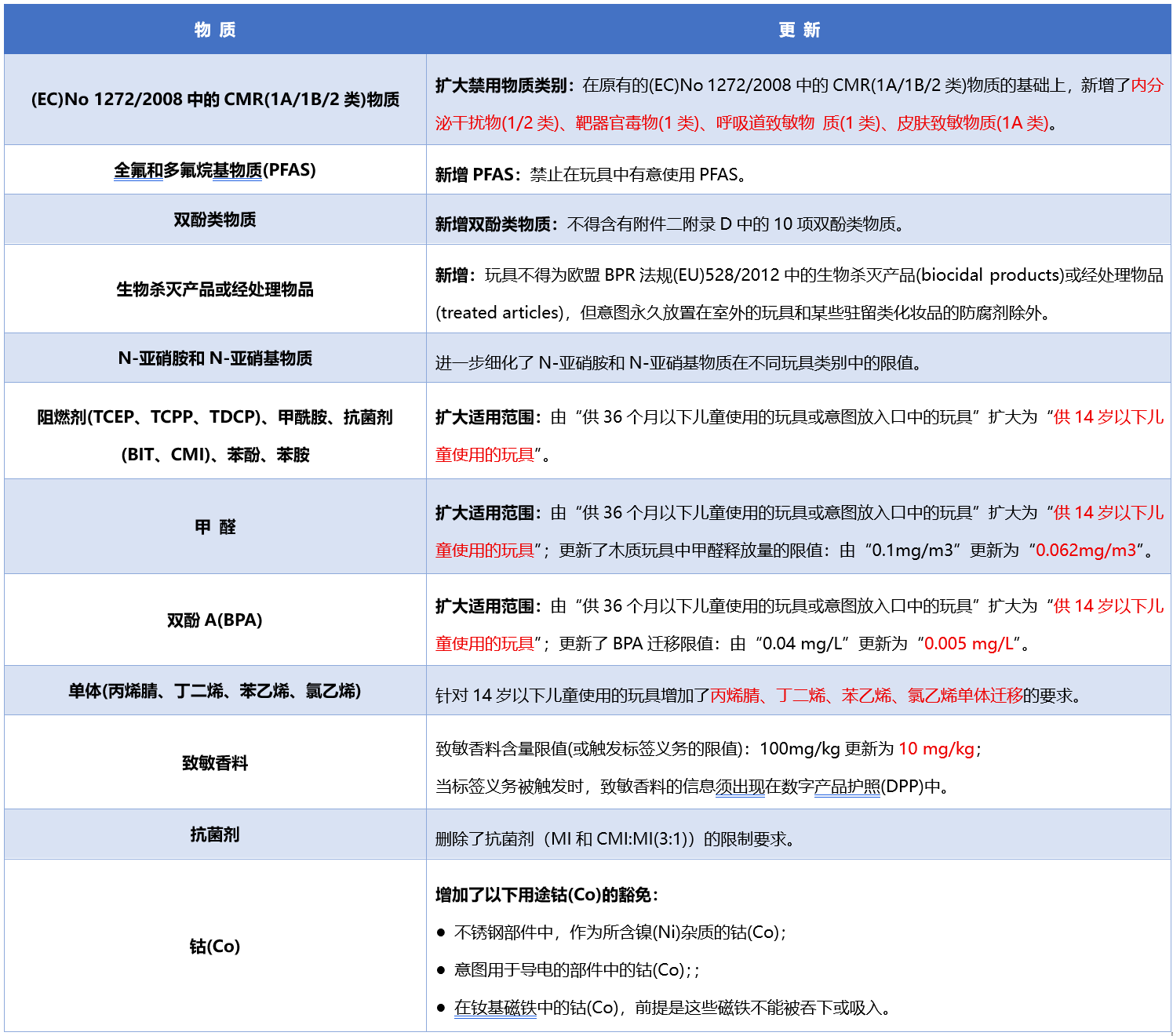
◆ Compliance tip: Enterprises need to contact professional testing and certification institutions to carry out chemical testing according to the requirements of the new regulations, so as to avoid the normal sales of products being affected by compliance problems and causing unnecessary economic losses.
Suggestions on enterprise compliance
1. Quick benchmarking: sort out the product list of the enterprise, and make clear the compliance items that need to be added/adjusted according to the TSR update points;
2. Pre-testing: give priority to testing institutions with EU regulations, carry out pre-testing of the whole project according to the requirements of the new regulations, find problems in advance and rectify them;
3. Document upgrade: Start the preparation of digital product passport (DPP), and integrate the core materials such as test report and compliance statement to ensure the traceability of information;
4. Long-term layout: integrate TSR requirements into the whole process of product design and supply chain management and control, and establish a monitoring mechanism for normal combination rules.
Warm tips
EU Toy Safety Regulation (EU) 2025/2509(TSR) will be officially implemented on January 1, 2026. ZRLK suggests that relevant enterprises should raise their risk awareness of their products, pay close attention to the changes of toy standards and the implementation time in time, and conduct a comprehensive compliance assessment of products in advance to ensure that products meet the requirements of relevant standards when put into the market and avoid unnecessary economic losses. Our company has a professional technical team and rich experience in product testing, which can help enterprises enter the target market in compliance with regulations. If you need it, please feel free to contact us, and our engineers will serve you at the first time!