On November 5, 2025, South Korea's Ministry of Science and ICT issued Public Notice No. 2025-56, "Technical Standards on Charging and Data Transmission Methods for Broadcasting and Communication Equipment such as Mobile Smart Devices," stipulating that from November 6, 2026, the 13 categories of mobile smart devices on the control list must be equipped with a compliant USB Type-C receptacle when placed on the South Korean market, when applying for KC certification, and at the customs clearance stage, with interface conformity incorporated into whole-unit KC assessment; products that fail to meet the requirements cannot complete KC certification and are prohibited from import and from online and offline circulation and sale.
Core conclusion: from November 6, 2026, products in the 13 categories that have wired charging or wired data transmission functions must use a unified USB Type-C receptacle compliant with the IEC/EN 62680-1-3 specification, and be incorporated into whole-unit KC assessment; products that fail the assessment will be excluded from the South Korean market.
I. Policy Background and Legislative Intent
| Key Element | Content |
|---|---|
| Issuing Authority | Ministry of Science and ICT (MSIT), South Korea |
| Notice Number | No. 2025-56 |
| Notice Title | "Technical Standards on Charging and Data Transmission Methods for Broadcasting and Communication Equipment such as Mobile Smart Devices" |
| Legal Basis | Article 28, Paragraph 9 of the "Framework Act on Broadcasting and Communications Development" |
| Date of Issue | November 5, 2025 |
| Mandatory Implementation Date | November 6, 2026 (one full year after issuance) |
| Core Requirement | Devices on the control list shall uniformly adopt a USB Type-C receptacle, with interface conformity incorporated into KC assessment |
The objectives of this South Korean legislation are consistent with the EU's charger harmonization regulations, mainly at three levels: reducing discarded charging cables and electronic waste; improving interoperability between chargers and data cables of different brands; and lowering consumers' repeated purchase costs. The notice also explicitly states that controlled devices may no longer use proprietary interfaces such as Micro-USB and Lightning, and that the physical structure, dimensions and compatibility of the interface must meet the IEC/EN 62680-1-3 technical specification.
II. Scope of Application and Determination Logic
The determination standard in one sentence: if the device body has a built-in wired charging or wired data transmission interface, it falls within the control scope. Products that support only wireless charging and have no wired interface are not subject to this clause.
The 13 product categories brought under control: mobile phones, tablets, digital cameras, over-ear headphones, in-ear headphones, earphones, portable game consoles, portable speakers, e-books, keyboards, mice, portable navigation devices, and laptop computers.
Three key application boundaries must be clearly drawn:
Applicable timing: it governs both "newly launched" and "new batch" products. The new rules apply to models newly applying for KC, newly imported, and newly launched. Although a transition arrangement is provided for existing inventory, newly produced batches and newly declared goods are all subject to the new rules, and inventory digestion does not constitute grounds for exemption.
Products not yet covered. Power adapters, standalone data cables and power banks are not included in this mandatory interface list. Note, however: power banks have separate KC safety requirements in South Korea and belong to a different compliance system; enterprises should not confuse the two sets of requirements.
How the certification system connects. The new rules do not create a new standalone certificate; rather, they incorporate USB-C interface conformity into the whole-unit broadcasting and communication equipment KC assessment system. When the whole unit is submitted for testing, the interface component must simultaneously meet the technical standards; interface components may complete component-level certification in advance, and the test report or component certificate can be referenced directly at the whole-unit application stage, thereby avoiding duplicate testing and shortening the certification cycle.
III. Technical Specification Requirements
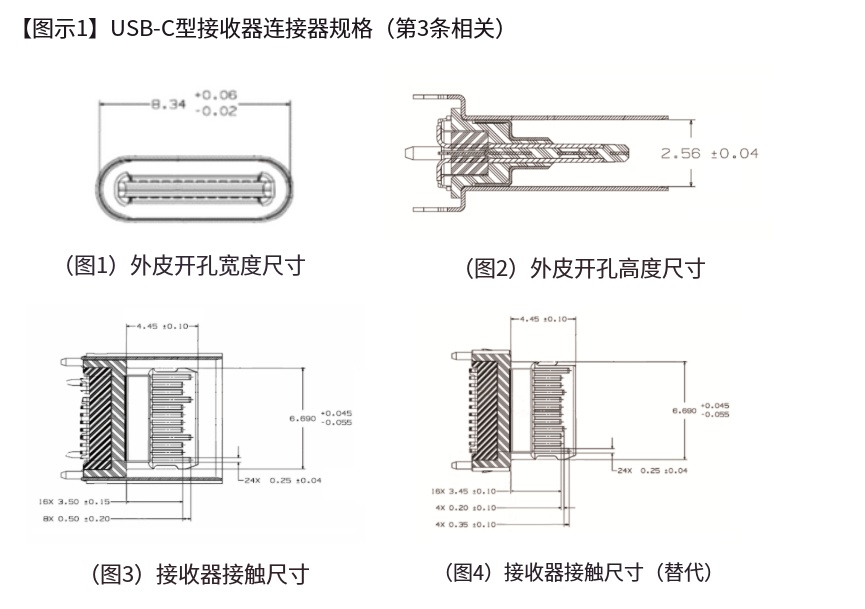
In accordance with the annexes to the notice and the IEC/EN 62680-1-3 specification, the key dimensions of the USB-C receptacle are all under strict tolerance control:
| Dimension Item | Nominal Value | Tolerance |
|---|---|---|
| Shell opening width | 8.34 mm | −0.02 / +0.06 mm |
| Shell opening height | 2.56 mm | ±0.04 mm |
| Receptacle tongue width | 6.690 mm | −0.055 / +0.045 mm |
| Receptacle tongue length | 4.45 mm | ±0.10 mm |
| Signal contact width (per pair) | 0.25 mm | ±0.04 mm |
| Signal contact length under conductive shell structure | 3.50 mm | ±0.15 mm |
| Signal contact length under non-conductive/no-shell structure | 3.45 mm | ±0.10 mm |
Under both conductive-shell and non-conductive-shell structures, there are additional stepped requirements for the length difference of the power and ground contacts relative to the signal contacts; procurement and quality teams need to verify them item by item against the original drawings.
The assessment dimensions are likewise not limited to static dimensions: mechanical structure, plug-and-pull durability, reverse-insertion prevention design, and interoperability with third-party chargers and cables are all within the scope of verification. Practical feedback shows that some low-priced connectors have dimensional deviations, substandard latch structures and other problems, making them a high-frequency failure point in testing. Enterprises are advised to complete dimension and structure verification at the component selection stage to reduce whole-unit test failures and subsequent rework costs.
IV. Regulatory Requirements and Consequences of Violations
After the new rules take effect, the National Radio Research Agency of South Korea is responsible for supervision and post-market spot checks, covering three scenarios: customs clearance, e-commerce platforms and offline retail stores:
No compliant test records: the KC application will be rejected and the goods will be held at customs;
Certificate information inconsistent with the actual interface: deemed fraudulent certification, subject to recall and administrative penalties;
Platform-side compliance review: mainstream e-commerce platforms such as Coupang and Gmarket require merchants to upload interface test materials, and non-compliant products will be forcibly delisted.
Compliance documentation therefore carries multiple attributes at once: it is a certification document, a customs clearance credential, and self-evidentiary material for responding to market spot checks; its completeness and traceability directly affect the continued sale of the product in South Korea.
Interface unification is a specification requirement at the technical level, but at the market level it is a restructuring of access rules. Following the EU, South Korea has moved quickly to follow suit, and compliance requirements around USB-C in major global markets are converging rapidly. We hold IEC/EN 62680 testing qualifications and can provide enterprises with one-stop services covering USB-C interface component-level testing and whole-unit KC certification. If you would like to learn more about the new rules or the submission process, please leave a comment or contact us via private message.